
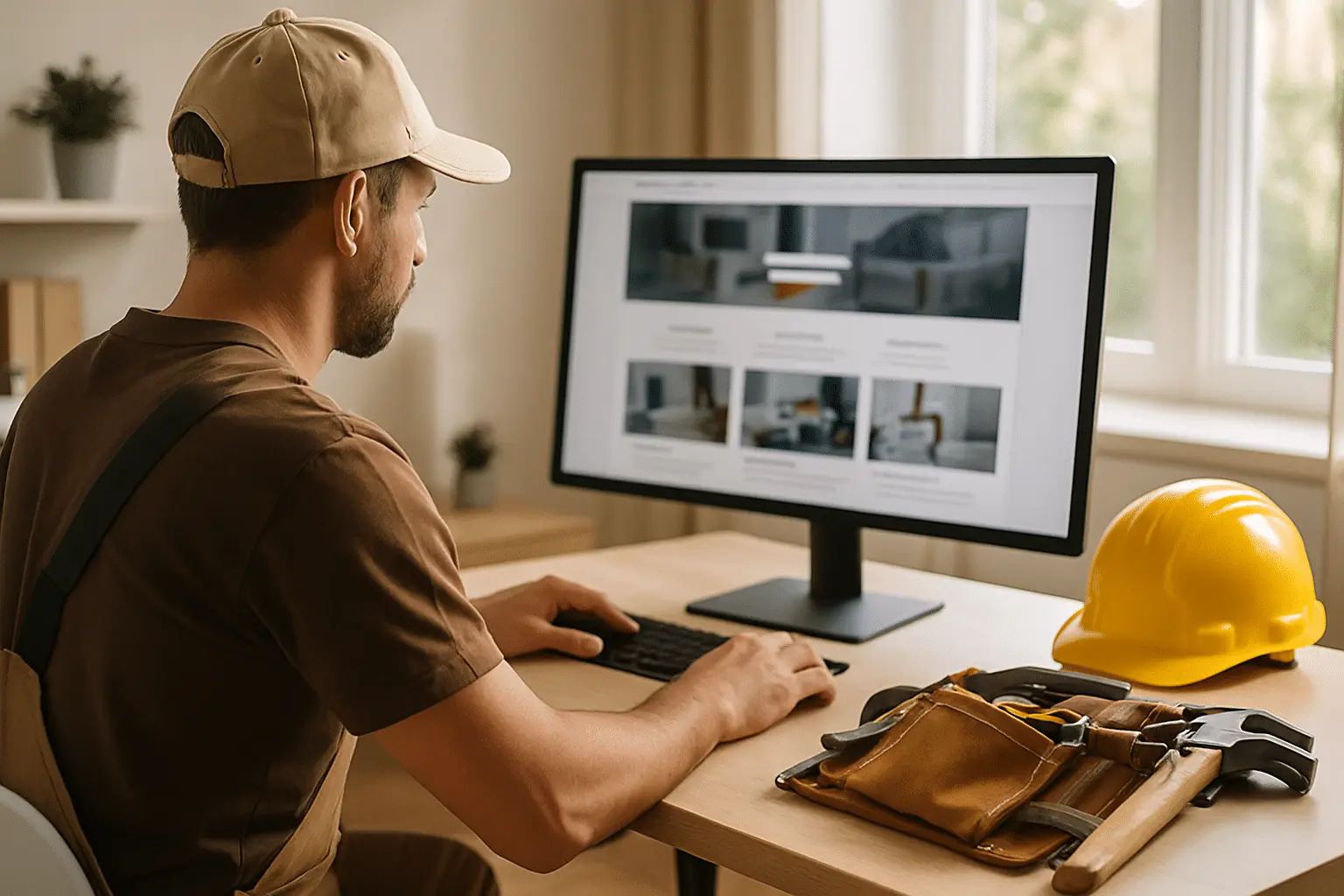
TL;DR: Most home service contractor websites leak leads through slow load times, missing trust signals, and weak calls to action — problems that are entirely fixable. This guide covers 10 of the most common website mistakes roofing, HVAC, fencing, pool, and other home service businesses make, with straightforward fixes for each. Patch these issues and your site works as a 24/7 lead machine instead of a digital brochure nobody calls from.
You built your contracting business on referrals, hard work, and showing up on time. But when a homeowner finds your website at 10 PM after a storm tears through their neighborhood, your site has to close the deal on its own.
The hard truth: most contractor websites fail that test. They’re slow, vague, hard to use on a phone, and give visitors no clear reason to call you instead of the next company on the list.
Here are 10 website mistakes home service businesses keep making — and how to fix every one of them.
1. Your Site Loads Too Slowly on Mobile
Speed isn’t a nice-to-have. It’s the difference between a lead and a bounce. 53% of users abandon mobile sites that take over 3 seconds to load, and 79% are unlikely to return after a slow experience. That’s nearly four out of five potential customers gone forever.
As of 2024, mobile devices account for 58.54% of global website traffic — and for home service contractors, that number skews even higher. Seven in ten homeowners searching for a contractor are on a smartphone, and the urgency context is clear: they are dealing with something that needs to be fixed.
Average mobile page load times are still at 8.6 seconds — well above Google’s recommended threshold. A one-second delay costs 7% in conversions, and only 33% of websites pass all Core Web Vitals.
The fix: Compress and convert images to WebP format, minimize plugins, and use a host that prioritizes performance. If your current site consistently loads in more than 3 seconds on mobile, it’s time for a rebuild.
2. No Clear Call to Action Above the Fold
A homeowner lands on your homepage. What do they see first — a stunning hero image with your company name, or a clear invitation to call, get a quote, or book an appointment?
Most contractor sites bury the action. Your phone number should be tappable in the top-right corner of every single page. A prominent “Get a Free Estimate” button should appear before any scrolling is required. Research found that 78% of customers hire the company that responds first, and response time is the single strongest predictor of conversion. If visitors can’t figure out how to reach you in under five seconds, they won’t.
The fix: Put a click-to-call phone number and a single, high-contrast CTA button in the header. Every service page needs its own CTA — not just a generic contact link.
3. Thin or Generic Service Pages
One catch-all “Services” page is not an SEO strategy. It’s a dead end. When a homeowner types “gutter installation Houston TX” into Google, they need to land on a page dedicated to gutter installation — one that explains your process, your materials, your service area, and why you’re the right choice.
Generic pages also torpedo your local search rankings. A contractor who shows up in one part of a metro can be invisible two zip codes over — without location-specific pages on your website and the right geographic signals, you’re leaving entire neighborhoods uncaptured, even if you work there every day.
The fix: Build a dedicated page for every service you offer. Include local city or metro references, describe your actual process, and add a service-specific lead form. This is one of the highest-leverage things you can do for both SEO and conversions. For a deeper look at what’s making your pages underperform, see our guide on 7 signs your contractor website is losing you leads.
4. Missing or Outdated Social Proof
Reviews aren’t decoration. They’re the deciding factor for most homeowners. A survey by Clear Seas Research found that 91% of homeowners rate online reviews as an important factor when choosing a contractor. 85% of homeowners research contractors online before making a hiring decision, and of those, 78% said online reviews were a major factor in choosing which contractor to contact.
Yet most contractor websites either don’t display reviews at all, or show a handful of undated testimonials that no one believes. 73% of consumers only pay attention to reviews written in the last month — so even a wall of five-star reviews from 2022 won’t move the needle.
56% of consumers select a business if it has positive ratings displayed in the Google Local Pack, but your website is the place where that trust gets deepened before someone picks up the phone.
The fix: Embed a live Google Reviews widget on your homepage and key service pages. Feature recent, specific testimonials — the ones that mention a real service, a real problem solved. And actively request new reviews from every completed job.
5. No Lead Capture Beyond a Contact Form
Most contractor websites convert only 2–3% of visitors into a form submission, leaving 97–98% of visitors anonymous. A static contact form is one of the weakest lead capture tools available — and yet it’s all most contractor sites offer.
Homeowners want convenience. They want to ask a quick question via chat, text, or an SMS widget at 11 PM — not fill out a formal form and wait two business days for a reply. Responding within 60 seconds increases conversion by 391%, and waiting just 5 minutes drops conversion probability by 80%.
The fix: Add an AI chat widget or SMS lead capture so visitors can get a quick response any time of day. Even a simple “Text us now” button dramatically increases after-hours engagement. Every Scalable Websites plan includes instant lead capture with SMS and email alerts, and the AI Enhanced plan adds AI SMS and chat — not an expensive add-on.
6. No Proof of Licensing, Insurance, or Credentials
Homeowners are handing you the keys to their biggest asset. They want to know you’re legitimate before they call. If your website doesn’t clearly display your license number, insurance status, and any relevant certifications, you’re creating doubt at the most critical moment in the decision process.
97% of consumers read reviews and research a business online before hiring a local service provider — and if any of those places leave questions unanswered, you are losing leads you never knew you had.
The fix: Add a trust bar or footer section that prominently displays your license number, insurance carrier, years in business, and any manufacturer or trade certifications (GAF, NRCA, ACCA, etc.). Don’t make visitors dig for this information.
7. Poor or Missing Project Photography
Nobody hires a roofer without seeing roofs. A fencing contractor without fence photos is asking for a leap of faith no homeowner will take. But most contractor sites either skip project photos entirely or use manufacturer stock images that look exactly like every competitor’s site.
When you do use real photos, the technical execution often tanks the site. Photos come straight off a phone at 4MB each, dropped onto the page at full resolution. A gallery page with 30 unoptimized images takes several seconds to become usable — and visitors leave before the first image renders.
The fix: Shoot before-and-after photos on every job. Resize images to their display dimensions, export as WebP, and lazy-load anything below the fold. Cap gallery pages at a reasonable number of images with pagination beyond that.
8. No Local SEO Foundation
You can have a beautiful website and still be invisible in search if the basic local SEO signals are missing. That means: location-specific page content, consistent NAP (name, address, phone) across your site and Google Business Profile, schema markup, and service-area signals that tell Google exactly where you work.
Your Google Business Profile should tie back to your site — matching name, address, and phone, with your service pages linked from the profile. Yet a 2025 LocaliQ report found only 15% of home services listings had complete and correct information. That’s a low bar — and an easy competitive advantage to claim.
Over four in ten local searchers click a map pack result, compared to 10–15% who click the organic results below the map. If your site isn’t sending the right signals to support your Google Business Profile, you’re not competing for that prime real estate.
The fix: Audit your NAP consistency across your website, GBP, and every directory listing. Add LocalBusiness schema markup to your homepage and service pages. Build location-specific service pages for every major market you serve.
9. No Clear Service Area Communication
“Serving the Greater Houston Area” is not a service area page. Visitors — and Google — need specificity. Which cities? Which counties? Do you travel for larger commercial jobs? Are there zip codes you don’t cover?
Vague service area language wastes ad spend, attracts unqualified leads, and fails to rank for the geo-specific searches where jobs actually get won. Searches for services “near me” have quadrupled — homeowners are not typing a specific company name, they are typing what they need and letting Google find someone local.
The fix: Create a service area page that lists every city and community you serve. Link to individual city-specific service pages where volume justifies it. Embed a map. The more specific you are, the better Google can match you to high-intent local searches.
10. A Website That Was Built Once and Never Touched Again
A contractor website is not a set-it-and-forget-it asset. Google rewards freshness. Homeowners notice when content is outdated. And the market you’re competing in changes — new competitors launch, services evolve, and your best case studies from three years ago are no longer your most compelling proof.
Google rewards businesses that actively manage their profile, earn new ratings consistently, and keep their information accurate. A competitor who treats their listing like a living marketing channel and updates it weekly will outrank one who set it up two years ago and hasn’t touched it since. The same principle applies to your website itself.
Outdated pricing, discontinued services, or a phone number that changed two years ago all erode trust instantly. Studies show it takes just 0.05 seconds for users to form a first opinion of a website — and a stale site signals a business that may not be paying attention.
The fix: Make sure someone owns website maintenance on your team — or work with a provider who handles unlimited updates as part of your monthly plan. Add new project photos regularly, refresh seasonal service messaging, and update your reviews widget so it pulls in recent ratings automatically.
The Bottom Line
None of these mistakes are fatal — but together, they silently drain your lead flow every single day. The good news: every fix on this list is achievable without a massive rebuild budget.
If you’re wondering what your current site is actually costing you, start with our breakdown of 7 signs your contractor website is losing you leads. And if you’re weighing what a proper contractor website should actually cost in 2026, our contractor website cost guide breaks it down without the agency runaround.
At Scalable Websites, we build and manage AI-powered contractor websites on a simple monthly subscription — hosting, security, and unlimited updates included. No surprise invoices, no chasing a developer every time you need a phone number changed. Just a site that works as hard as you do.
Recommended Reads
- 7 Signs Your Contractor Website Is Losing You Leads (And How to Fix It)
- How Much Should a Contractor Website Cost in 2026?