
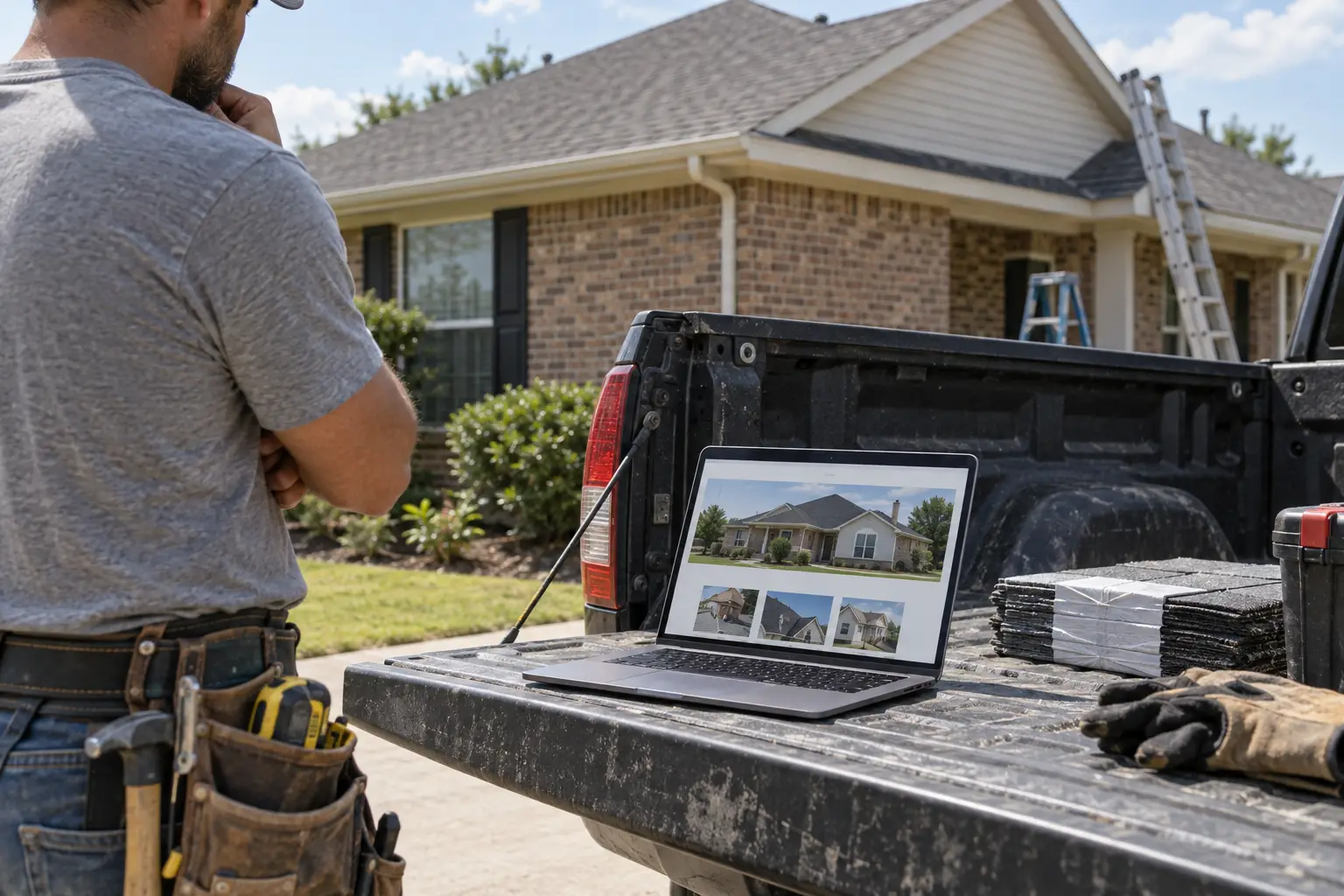
TL;DR: A month-to-month website for contractors is built for you and paid for monthly instead of with a big upfront fee. Hosting, security and updates are included. Most plans have a short minimum term and then renew monthly. Before you sign, check how long the minimum is, who owns the site and domain, and how redirects will protect your Google rankings if you ever leave.
A month-to-month website for contractors is a site you pay for monthly instead of paying a large build fee up front. The provider builds it, then hosts, secures and updates it for one flat price. Most plans have a short minimum term. After that, you can cancel in any month.
Based in Montgomery County? See how we handle website plans for Montgomery, TX businesses.
Offers differ in the fine print. Check three things: how long the minimum lasts, who owns the site and domain, and what happens to your Google rankings if you leave. Here is how each piece works.
How does a month-to-month website for contractors work?
You pay one monthly fee, and the provider handles the build and the upkeep. Most plans follow the same five steps:
- Kickoff. You send your services, service area, logo and job photos.
- Build. The provider writes and designs the pages, sets up lead forms and connects tracking like Google Analytics.
- Launch. The site goes live on your domain name.
- Upkeep. Each month, the fee covers hosting, security, backups and the changes you ask for.
- Rollover. Once the minimum term ends, the plan renews month to month until you cancel.
The biggest difference from a traditional build is cash flow. A one-time build asks for the full cost before launch. A monthly plan spreads it out. For a new fence company or a lawn care crew in its first season, that leaves money for trucks, materials and payroll.
Why do month-to-month plans still have a minimum term?
The provider does most of the work before you have paid much. Writing service pages, building forms and setting up tracking all happen in the first few weeks. A minimum term lets the provider recover that cost if a client leaves early.
The length is what matters. A 6-month minimum is a much smaller commitment than a multi-year contract, even if both are sold as monthly plans. Ask these questions before you sign:
- How many months is the minimum, and does it start at signup or at launch?
- Does anything restart the minimum, like a redesign or a plan change?
- Once the minimum ends, how do I cancel, and how much notice do you need?
- Are any usage charges, like text message fees, billed on top of the monthly price?
Get the answers in writing. A clear plan puts the minimum, the price and the steps to cancel where you can find them.
Month-to-month vs. long-term contract vs. one-time build
Each option trades upfront cost against commitment and control. Here is how they compare.
| Option | Upfront cost | Commitment | Who handles upkeep | Main risk |
|---|---|---|---|---|
| Month-to-month subscription | Low or none | Short minimum, then monthly | Provider (hosting, security, updates) | You may not own the site unless the plan says so |
| Long-term website contract | Low or none | A fixed term set in the contract | Provider | Hard to leave early if service slips |
| One-time build | Full build cost before launch | None after payment | You, or a separate maintenance plan | The site goes stale or breaks if no one maintains it |
A one-time build usually gives you full ownership on day one. The catch is that hosting, security updates, backups and content changes become your job or a separate bill. For a fair comparison, add up the total cost over three years, including upkeep, not just the first invoice.
What happens to your website and domain if you cancel?
That depends on who owns the domain name and who owns the site itself. Those are two separate things, so check both.
Your domain name
Your domain is your web address, like yourcompany.com. According to ICANN, the registrant is the person or business that registers a domain. The registrant signs a contract with a registrar and manages the domain through that registrar. Ask for your business to be listed as the registrant, and keep the login. If the domain auto-renews, ICANN says the registrant has to keep payment details current. An expired card could put the name at risk.
Your site and design
Many subscriptions work like a rental. You keep your domain, but the design, pages and code stay with the provider when you cancel. Some plans transfer ownership after a set number of months. Ask for the exact month in writing.
Your Google rankings
Rankings can hold through a move if it’s done right. If page addresses change, Google’s site move guide recommends permanent redirects, such as 301s, from each old page to its matching new page. Google also advises keeping those redirects for generally at least 1 year and not sending lots of old pages to the new home page. Whoever builds your next site should handle this for you.
Pros and cons of a monthly contractor website
Pros:
- Low upfront cost, so cash stays in the business.
- Hosting, security and backups are someone else’s job.
- When updates are included, new services, seasonal specials and job photos go up without a separate invoice.
- You can leave after the minimum if the site isn’t pulling its weight.
- You get one predictable bill each month.
Cons:
- You keep paying for as long as you use it.
- Over many years, the total can be more than a one-time build would have cost.
- Unless the plan says otherwise, you may not own the design.
- You still owe the minimum term, even if you change your mind early.
- Usage-based features, like text messaging, may add charges on top of the base price.
When does a month-to-month website make the most sense?
It fits best when you want a working, maintained site without a big check or a long lock-in. Common cases:
- New businesses that have never had a website and need to look established fast.
- Seasonal trades, like pool builders or HVAC companies, that want their promos changed as the season turns.
- Busy owners who don’t want to think about hosting, plugins or security.
- Growing companies that plan to add pages for new services or new towns later.
It fits less well if you have someone in-house who already manages websites, or if you need full control of the code from day one. With any plan, check the basics every site needs, like a mobile-friendly design that works on job-site phones and missed-call text-back for calls you can’t pick up. For more questions to ask a provider, read our guide on how to choose a web design company for your contracting business.
How Scalable Websites sets up its month-to-month plans
Here are our terms in plain language, so you can compare them with any other offer.
- We’re based in Houston, TX, and work with trades and contractors throughout the US.
- We’ve been in business since 2015 and have built hundreds of websites for 40+ trades, including roofing, HVAC, fencing, pools and fire protection.
- Every plan has a 6-month minimum, then goes month-to-month.
- We build everything up front, and you pay monthly.
- Starter is $95/month for a single landing page, Growth is $195/month for 3-5 pages, and AI Enhanced is $295/month for 10+ pages with blogging, AI SMS and chat.
- Every plan includes unlimited update requests, a dedicated project manager, custom lead forms, hosting and security, daily offsite backups and uptime monitoring.
- Clients own their website after 36 months.
- Every 36 months, clients get a free design refresh, which starts a new 6-month minimum.
- Every plan has a 30-day money-back guarantee.
- There are no long-term contracts and no surprise fees, and SMS and AI data rates are passed through to the subscriber.
These terms are the same for a roofing company in Houston and a fence company in Dallas.
If you want to see which plan fits your trade, schedule a consultation with Scalable Websites and we’ll go over the terms with you.
Frequently Asked Questions
Is a month-to-month website cheaper than paying for a build up front?
It costs less up front because you skip the large build fee. Over several years, the total may be higher or lower than a one-time build depending on what the monthly fee covers, so compare three-year totals that include hosting, security and updates.
Can I keep my domain name if I cancel a website subscription?
Usually, yes, as long as your business is listed as the domain’s registrant and you can log in to the registrar account. ICANN says registrants are entitled to information on how to transfer and renew their domain, so ask your provider about this before you sign.
Will switching to a new website hurt my Google rankings?
Rankings can drop if page addresses change and the old addresses aren’t redirected. Google recommends permanent redirects from each old page to its matching new page. It also says permanent redirects don’t cause a loss in PageRank.
What should the monthly fee include at a minimum?
Look for hosting, security, backups and a clear policy on update requests. Also ask which features, such as text messaging, have usage charges billed separately.
Can I change plans in the middle of a month-to-month subscription?
Many providers let you move up or down a plan. Ask whether changing plans restarts the minimum term before you make the switch.
Recommended Reads
- Why a Mobile-Friendly Website Is Non-Negotiable for Contractors
- Missed Call Text-Back for Contractors: How It Works and Why It Matters
- Google Business Profile Tips Every Contractor Should Know